
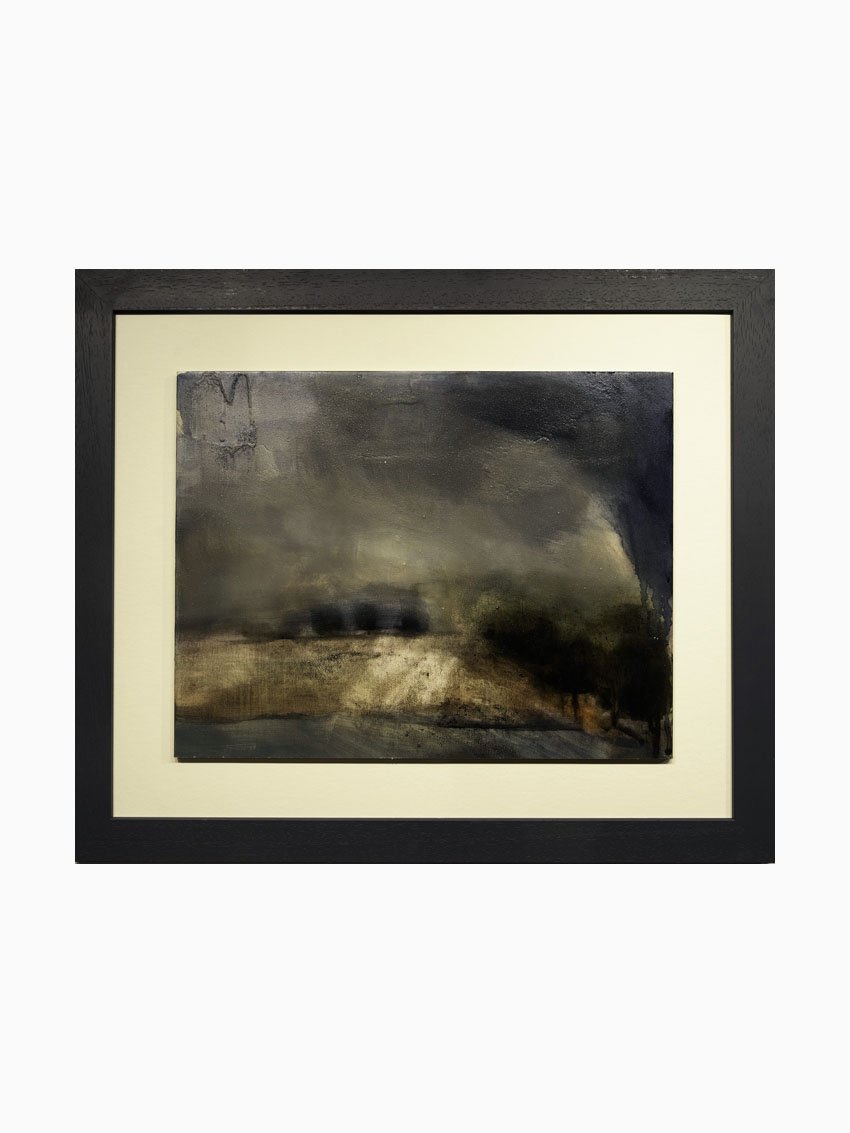
Oil and watercolour onto clay panel. This work is inspired by the shifting light of an incoming storm. Glaw Golau loosely translates as rain that is shifting over a landscape with bright sunlight to the east.
The process:
Each birch panel is covered with a specially formulated clay ground, that I’ve developed in the studio over the past few years. The surface is subtly textured and able to hold soft washes of watercolour which are built upon in oil. This results in works that are rich and atmospheric; elements that perfectly convey the Welsh landscape and ever shifting weather patterns.

Oil and watercolour onto clay and birch panel. Eira Lluchio is Welsh for “drifting snow”. Painted in the studio and inspired by colour notes and sketches from the Brecon Beacons. This work developed organically being partly informed by experience and partly a response to the mediums, the result is an abstraction of feelings, sight and sound from walking in the hills.
The process:
Each birch panel is covered with a specially formulated clay ground (this is an artistic term for a layer used to prepare a surface for painting). This is a wholly unique process, one that I’ve developed the recipe and application of over a number of years. This was born of a desire to marry two opposing elements; oil and watercolour.
My practice as an artist has centred around these two very distinct media - not traditionally used together in painting. I love watercolour for the soft, subtle bleeds that echo light transitions and more. It’s delicate and light, subtle and surprising. Oil paint on the other hand, has a depth and richness, its pigmentation mirrors nature's own. I wanted to marry these two qualities, the softness of watercolour and in particular the way that paper allows for those lovely bleeds, but find something that could withstand an oil paint (paper would degrade from the linseed oil in an oil paint if applied directly to it).
The clay ground was inspired by ancient frescos where egg tempura would be painted onto clay and lime walls. My paintings then become like modern frescos, learning and building upon ancient art forms to create a unique surface that behaves like a watercolour paper, allowing for gentle bleeds of colour but has the stability to support an oil paint. This results in works that are rich and atmospheric; elements that perfectly convey the Welsh landscape and ever shifting weather patterns.

Oil and watercolour on handmade clay panel. Bala is the largest natural lake in Wales, this piece is inspired by sketchbooknotes taken from its banks. Rich blues and golden shards of light are placed into this piece which echo the sentiments of times gone by. The subtle textures of the clay, layers of pigment and damar varnish, give this works an almost iridescent tone, as if you were looking through spring waters to view it.
The process:
Each birch panel is covered with a specially formulated clay ground (this is an artistic term for a layer used to prepare a surface for painting). This is a wholly unique process, one that I’ve developed the recipe and application of over a number of years. This was born of a desire to marry two opposing elements; oil and watercolour.
My practice as an artist has centred around these two very distinct media - not traditionally used together in painting. I love watercolour for the soft, subtle bleeds that echo light transitions and more. It’s delicate and light, subtle and surprising. Oil paint on the other hand, has a depth and richness, its pigmentation mirrors nature's own. I wanted to marry these two qualities, the softness of watercolour and in particular the way that paper allows for those lovely bleeds, but find something that could withstand an oil paint (paper would degrade from the linseed oil in an oil paint if applied directly to it).
The clay ground was inspired by ancient frescos where egg tempura would be painted onto clay and lime walls. My paintings then become like modern frescos, learning and building upon ancient art forms to create a unique surface that behaves like a watercolour paper, allowing for gentle bleeds of colour but has the stability to support an oil paint. This results in works that are rich and atmospheric; elements that perfectly convey the Welsh landscape and ever shifting weather patterns.

Original oil and watercolour on handmade clay panel. The March was initially a response to an autumn walk, the dominant pigment here is Rembrandt red, a translucent, rich and fiery pigment that perfectly captured warm autumn colours.
The process:
Each birch panel is covered with a specially formulated clay ground (this is an artistic term for a layer used to prepare a surface for painting). This is a wholly unique process, one that I’ve developed the recipe and application of over a number of years. This was born of a desire to marry two opposing elements; oil and watercolour.
My practice as an artist has centred around these two very distinct media - not traditionally used together in painting. I love watercolour for the soft, subtle bleeds that echo light transitions and more. It’s delicate and light, subtle and surprising. Oil paint on the other hand, has a depth and richness, its pigmentation mirrors nature's own. I wanted to marry these two qualities, the softness of watercolour and in particular the way that paper allows for those lovely bleeds, but find something that could withstand an oil paint (paper would degrade from the linseed oil in an oil paint if applied directly to it).
The clay ground was inspired by ancient frescos where egg tempura would be painted onto clay and lime walls. My paintings then become like modern frescos, learning and building upon ancient art forms to create a unique surface that behaves like a watercolour paper, allowing for gentle bleeds of colour but has the stability to support an oil paint. This results in works that are rich and atmospheric; elements that perfectly convey the Welsh landscape and ever shifting weather patterns.

Original Oil on Canvass inspired by the falling winter sun and shards of golden light that it casts. This work reverberates colour against light and dark. Much like the rest of the series, this work develop organically; it is part lived experience part reflection of the thoughts, feelings and sense of movement whilst being outdoors.

Watercolour and oil onto handmade clay birch pannel. Inspired by the lakes of Wales and from sketch book notes from many hours spent roaming through the landscape. Der Torellog is an oed to hope and to the beauty of our natural landscape.
The process:
Each birch panel is covered with a specially formulated clay ground (this is an artistic term for a layer used to prepare a surface for painting). This is a wholly unique process, one that I’ve developed the recipe and application of over a number of years. This was born of a desire to marry two opposing elements; oil and watercolour.
My practice as an artist has centred around these two very distinct media - not traditionally used together in painting. I love watercolour for the soft, subtle bleeds that echo light transitions and more. It’s delicate and light, subtle and surprising. Oil paint on the other hand, has a depth and richness, its pigmentation mirrors nature's own. I wanted to marry these two qualities, the softness of watercolour and in particular the way that paper allows for those lovely bleeds, but find something that could withstand an oil paint (paper would degrade from the linseed oil in an oil paint if applied directly to it).
The clay ground was inspired by ancient frescos where egg tempura would be painted onto clay and lime walls. My paintings then become like modern frescos, learning and building upon ancient art forms to create a unique surface that behaves like a watercolour paper, allowing for gentle bleeds of colour but has the stability to support an oil paint. This results in works that are rich and atmospheric; elements that perfectly convey the Welsh landscape and ever shifting weather patterns.
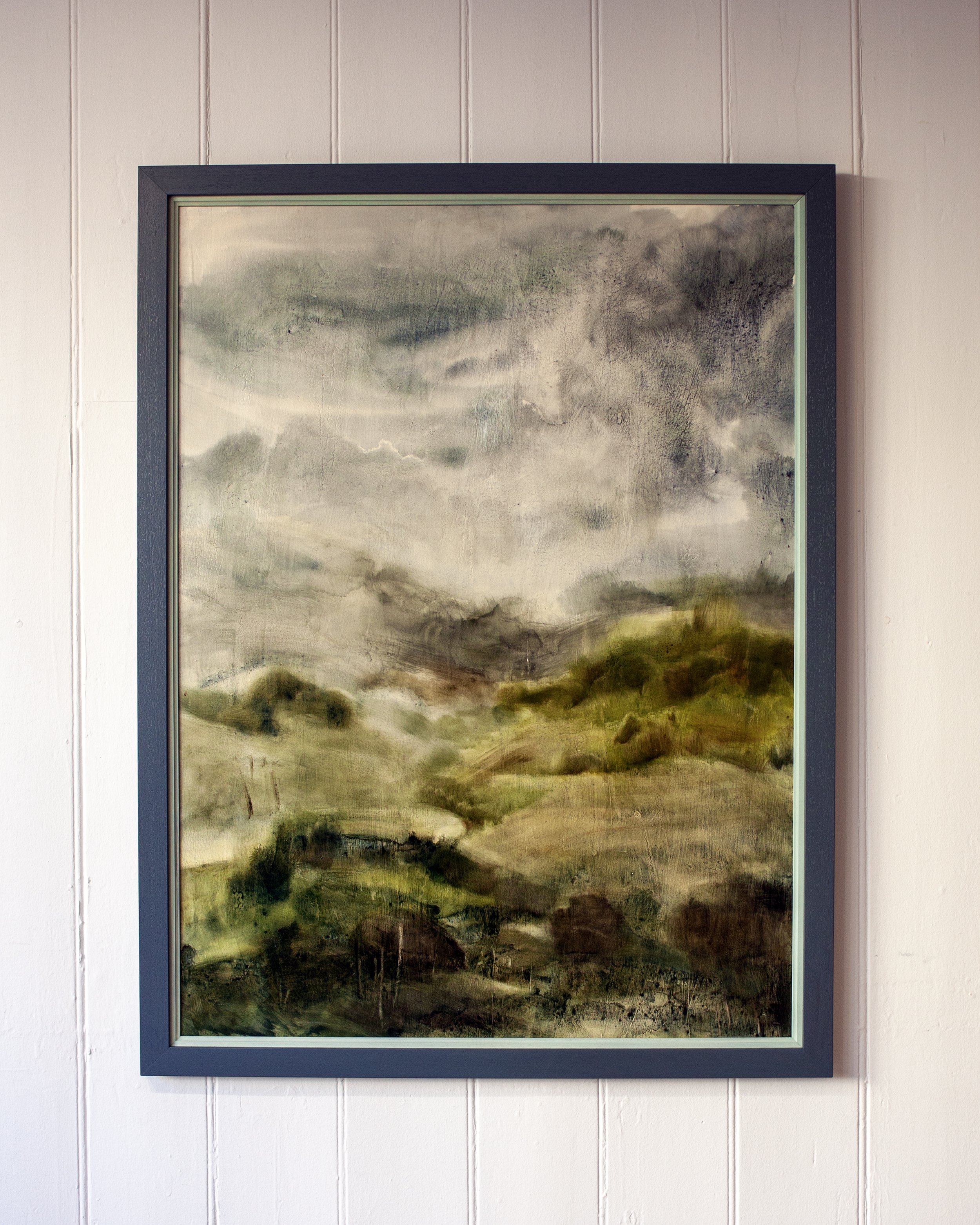
Watercolour and oil onto handmade clay birch panel. Inspired by the rolling hill lines of South Wales and from sketchbook notes from many hours spent roaming through the landscape. Through the Echoes is inspired by soaring hill lines and places never reached
The process:
Each birch panel is covered with a specially formulated clay ground (this is an artistic term for a layer used to prepare a surface for painting). This is a wholly unique process, one that I’ve developed the recipe and application of over a number of years. This was born of a desire to marry two opposing elements; oil and watercolour.
My practice as an artist has centred around these two very distinct media - not traditionally used together in painting. I love watercolour for the soft, subtle bleeds that echo light transitions and more. It’s delicate and light, subtle and surprising. Oil paint on the other hand, has a depth and richness, its pigmentation mirrors nature's own. I wanted to marry these two qualities, the softness of watercolour and in particular the way that paper allows for those lovely bleeds, but find something that could withstand an oil paint (paper would degrade from the linseed oil in an oil paint if applied directly to it).
The clay ground was inspired by ancient frescos where egg tempura would be painted onto clay and lime walls. My paintings then become like modern frescos, learning and building upon ancient art forms to create a unique surface that behaves like a watercolour paper, allowing for gentle bleeds of colour but has the stability to support an oil paint. This results in works that are rich and atmospheric; elements that perfectly convey the Welsh landscape and ever-shifting weather patterns.